
Guardsman Air Duct Cleaning in Lakewood: A Homeowner’s Guide
If you bought a home warranty or furniture package that included “duct cleaning,” you probably assumed the ducts would actually get cleaned. Here’s the part the brochure skips: Guardsman-dispatched crews often arrive with a portable vacuum rated for upholstery, not the negative-pressure equipment used for a full system clean. A Guardsman visit can be a useful starting point, but it covers less than most Lakewood homeowners expect. This guide breaks down what the contract includes, what it leaves behind, and what to verify before anyone shows up.
If reading the fine print sounds like a worse afternoon than cleaning the ducts yourself, call (844) 625-7378 and we’ll walk you through it.
What Does the Guardsman Duct Cleaning Clause Actually Cover?
A Guardsman home-service warranty typically authorizes a “duct cleaning” visit as a covered convenience service. In practice, that usually means a technician runs a vacuum through the main trunk lines for a set period. It does not mean a full NADCA-method cleaning of every component in your system. The clause is real, but it’s narrow.
Here’s what Lakewood homeowners tend to find after reading the exclusions:
- Trunk lines only. The main supply and return trunks are the focus. Branch runs feeding individual rooms often aren’t touched.
- No register removal. Supply registers and return grilles usually stay in place, so debris sitting behind them stays put.
- The air handler is exempt. The blower compartment and evaporator coil, where a lot of contamination collects, are typically out of scope.
- No repair or sealing. Disconnected joints, crushed flex runs, and leaking seams are noted at best, never corrected.
- No sanitizing. Microbial growth and odor treatment are separate services, not part of the visit.
None of this makes Guardsman dishonest. It makes it a defined product. The problem is that the definition is much smaller than what “duct cleaning” means to most people who live in a house with a forced-air system running five months of the year against Lakewood’s dry, dusty air.
Why Does Equipment Matter More Than the Brand on the Contract?
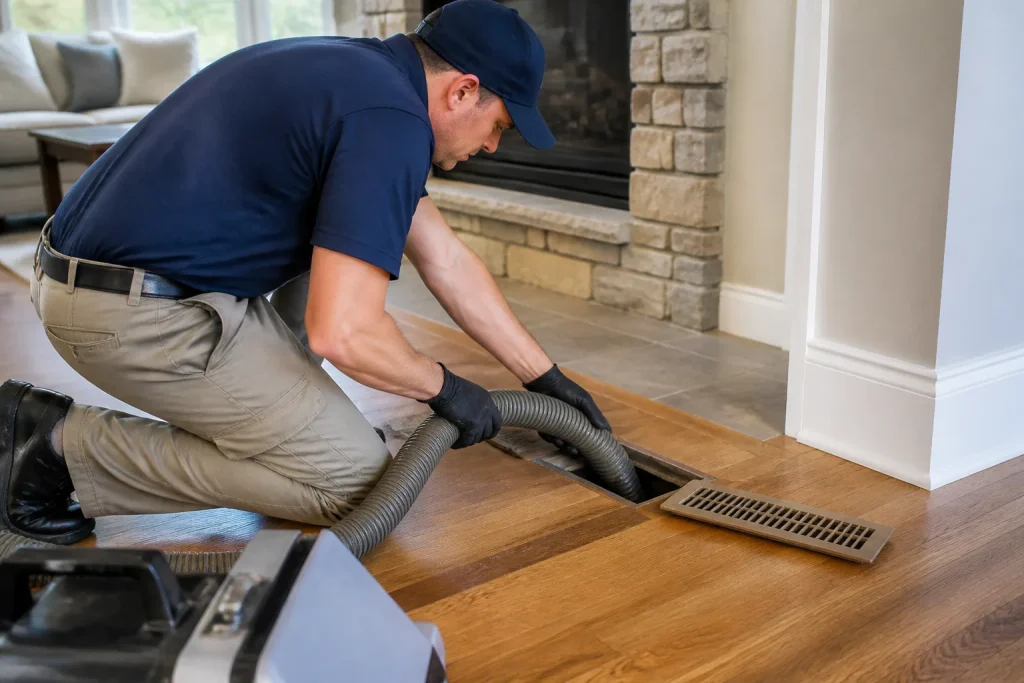
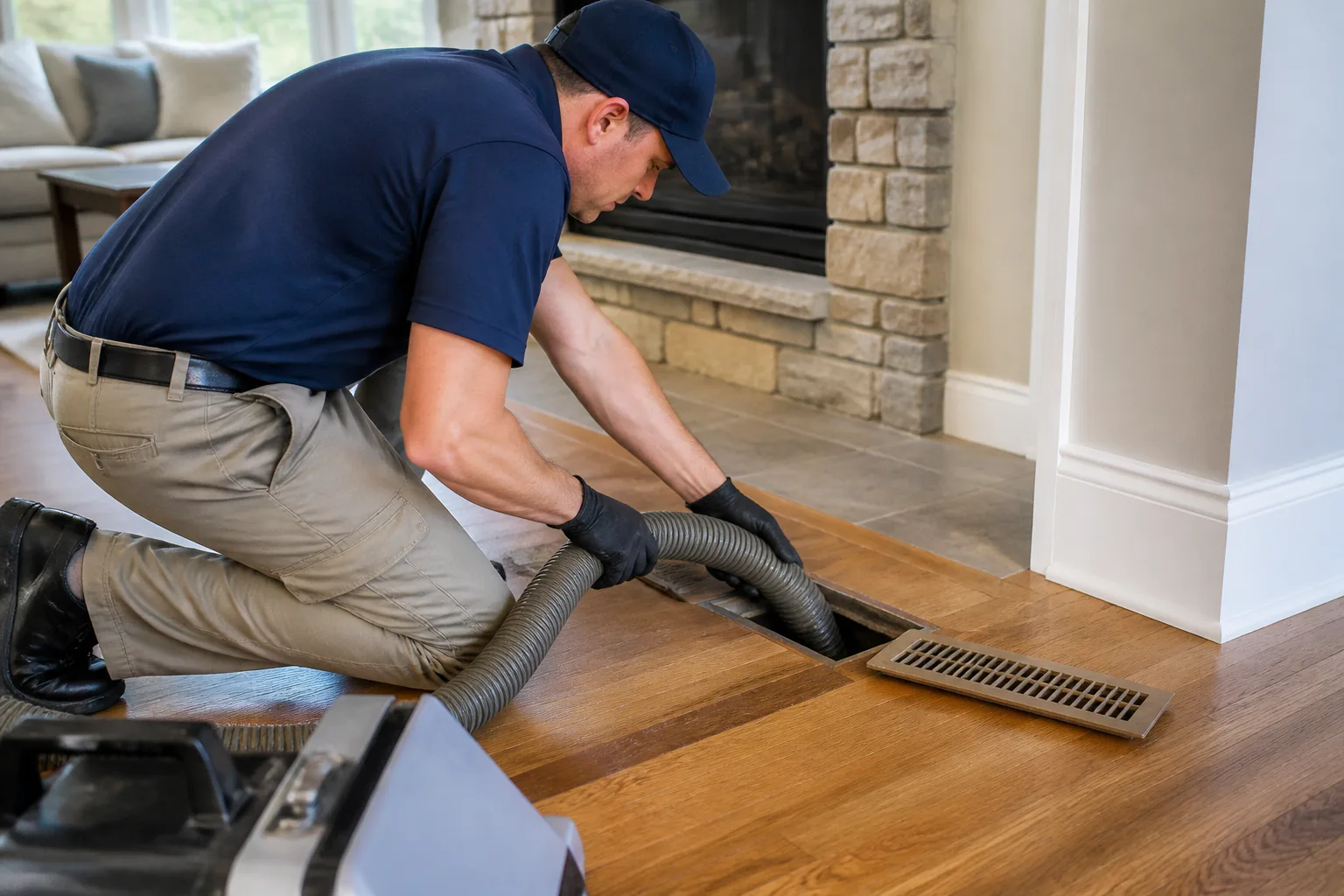
Duct cleaning is only as good as the machine doing it. The recognized standard for a full system clean is source removal under negative pressure: seal the system, put it under vacuum, then agitate the debris loose so it’s captured, not just stirred up. Truck-mounted units or high-CFM portables with HEPA filtration are built for that job. A portable unit designed for furniture upholstery is not.
This matters in Lakewood’s climate specifically. Our high-desert dust is fine and powdery, and it settles into ductwork and coats surfaces. Cleaning it requires real suction at the source, plus contact agitation to break the bond between debris and duct wall. Without both, you mostly redistribute dust.
When a Guardsman-dispatched tech arrives, ask these questions before they start:
- What vacuum unit are you bringing, and what’s its CFM rating?
- Will you seal the system and run negative pressure during cleaning?
- Are you using a contact-cleaning tool (like a Rotobrush or Nikro whip) or just a hose?
- Will there be filtration running in the living space during the job?
- Can I see before-and-after photos of the inside of the ducts?
A pro with the right equipment will answer all five easily. A pro with the wrong equipment will change the subject. If you’d rather start with a service that uses professional-grade equipment, see what air duct cleaning involves when it’s done to NADCA methodology.
Where’s the Scope Gap When Guardsman Cleans Your Ducts?
The biggest complaint homeowners bring to us after a Guardsman visit isn’t that nothing happened. It’s that the same symptoms came back: musty smell in one bedroom, dust on the ceiling vents, an HVAC system that still cycles longer than it should. That’s the scope gap in action.
Here’s where Guardsman cleaning typically stops and where the rest of the system continues:
- Branch runs. The flex duct feeding an individual bedroom is often untouched. This is where dust, pet dander, and construction debris tend to accumulate most.
- Registers and grilles. The face of the vent and the housing behind it collect a layer of dust that visibly blows back into the room.
- The air handler cabinet. The blower wheel and coil surface are the real performance bottleneck. A dirty blower wheel cuts airflow and raises your energy bill.
- Return-side ductwork. Often neglected because it’s harder to reach and less photogenic than the supply side.
- Dryer vent. Completely separate from the HVAC ducts, completely separate from the warranty, and the leading cause of residential dryer fires.
If you want a full picture, a camera inspection after the warranty visit shows exactly what’s still inside. We’ve seen branch runs that a warranty service called “clean” hold a visible dust mat in the first few feet past the trunk takeoff. The camera doesn’t argue; it just shows what’s there.
How Do You Document Your System Before a Guardsman Visit?
The single most useful thing you can do is create a baseline. If the visit is thorough, you have proof. If it isn’t, you have a record for escalating the claim or deciding to supplement the work.
- Photograph every visible register and return grille. Note dust buildup on the grille face and inside the boot, before anything is touched.
- Note the symptoms. Write down what you smell, where the dust accumulates fastest, and any rooms that feel stuffier than others.
- Check the filter. Note the type, date installed, and how dirty it is. Save the old one or photograph it. A filter pulled after two months with heavy gray loading is a sign of system-wide debris.
- Ask for the scope in writing. Before work starts, ask the tech what components will be cleaned and request a written note if anything is excluded.
- Photograph after the visit. Same angles, same registers. This is what a camera inspection or a second crew will use to compare.
Two hours of documentation is far cheaper than replacing a blower motor because nobody noticed the airflow problem. The paperwork is boring. Actually cleaning the ducts is what matters.
When Should You Call a Pro Beyond the Warranty Service?
Call a professional team when the symptoms outlast the warranty visit. Specifically:
- You still smell mustiness or a stale scent when the system kicks on.
- A family member with allergies notices symptoms that track the HVAC cycle.
- You see dust puffing from a register when you turn the system on.
- The airflow in one or more rooms is weaker than the rest of the house.
- You’ve never had the system cleaned before, or it’s been more than a few years.
- The dryer takes two cycles to dry a load, or the vent flap on the outside wall seems stuck.
These are the same signals we look for when we do a walk-through. Our technicians have up to 12 years of experience, and the diagnostic process starts the same way every time: source-removal cleaning with Rotobrush contact tools and Nikro negative-pressure equipment, plus Abatement Technologies filtration running on-site to keep particulates out of your living space. Often the missing piece isn’t the cleaning, it’s the sealing. Compromised seams and disconnected joints reintroduce dust the moment the system runs.
If duct sealing turns out to be the culprit, that’s part of what a full-service visit covers. HVAC cleaning addresses the blower and coil, and the same visit can cover dryer vent cleaning while the crew is already set up.
The Bottom Line
Guardsman duct cleaning in Lakewood is a defined, limited service. It can remove debris from main trunk lines, and it can be a useful starting point, especially if you’ve never had any professional duct work done. It rarely covers branch runs, registers, the air handler cabinet, duct repair, or sanitizing. Those are the parts of the system where most of the air-quality and efficiency problems live.
The practical approach: use the warranty visit, document the system before and after, then follow up with a camera inspection and a full-system cleaning if the symptoms persist. Clean ducts, sealed ducts, safe ducts. Your HVAC system is only as clean as the ducts it breathes through, and a warranty clause is not the same thing as a complete clean.
If you’re in Lakewood and need help, Air Duct Cleaning Lakewood Pros offers free estimates. Call (844) 625-7378. We answer 24/7. Fast dispatch from 7am to 7pm, Sunday through Friday.
Frequently Asked Questions
It cleans the main trunk lines, which is a real service but a partial one. Branch runs, register boots, the air handler cabinet, and any sealing or sanitizing typically fall outside the warranty scope. If your goal is clean air from every vent in the house, expect to supplement the warranty visit with a full-system clean.
Ask for before-and-after photos of the inside of the ducts, and check them against your own baseline photos taken before the visit. If photos aren’t offered, or the same symptoms return within a few weeks, a camera inspection will tell you what was actually cleaned. Call (844) 625-7378 if you’d like a second opinion; estimates are free.
Because it’s a narrower job. A portable vacuum running through trunk lines takes far less time, labor, and equipment than sealing the system, running negative pressure, agitating every branch line, and capturing particulates with on-site filtration. Same word, “duct cleaning,” very different scope. If a quote seems too low, ask what equipment and which components are included.
Usually not. Dryer vent cleaning is a separate service from air duct cleaning and is rarely included in a home-service warranty. It matters because a clogged dryer vent is the leading cause of residential fires, and Lakewood homes with longer vent runs are particularly at risk. If it’s been more than a year, have it inspected. Call (844) 625-7378 for a free estimate.
Written by the team at Air Duct Cleaning Lakewood Pros.
Need Air Duct Cleaning Help?
Call Air Duct Cleaning Lakewood Pros - the local pro we connect you with is licensed and insured, here with fast help in Lakewood.
(844) 625-7378